
How to Define Time Horizon Before Choosing a Trading or Investing Strategy
admin - March 17, 2026Understanding Time Horizon in Trading and Investing
Time horizon is a foundational concept in both trading and investing. It refers to the length of time an individual expects to hold an investment before accessing the capital. While the idea appears straightforward, its implications are extensive. Time horizon affects asset allocation, portfolio construction, liquidity management, tax considerations, and the level of acceptable volatility. A clear understanding of this concept allows investors to design strategies that are structurally aligned with their financial goals.
A useful starting point for broader terminology and background can be found at https://www.investopedia.com/terms/t/timehorizon.asp, which outlines essential definitions commonly referenced in financial planning.
In practical terms, defining a time horizon transforms abstract goals into structured investment plans. Saving for a home purchase in two years demands a different strategy than preparing for retirement in thirty years. The distinction influences which securities are appropriate, how much volatility can be tolerated, and how returns should be evaluated.
Importance of Time Horizon
Time horizon serves as a bridge between financial objectives and portfolio design. Without a defined time frame, decisions about risk exposure and asset allocation become speculative. Investors may either assume excessive risk relative to their needs or adopt overly conservative strategies that limit potential growth.
A clearly defined time horizon contributes to consistency in decision-making. It discourages reactive behavior during periods of market volatility because decisions remain anchored to long-term objectives rather than short-term market movements. For example, an investor with a twenty-year horizon may respond differently to a market decline than someone who intends to use the capital within six months.
Time horizon also plays a significant role in return expectations. Historically, longer holding periods have reduced the probability of negative average returns in diversified equity markets. While no outcome is guaranteed, extended durations allow for recovery from short-term downturns and enable compounding to function effectively.
Risk Tolerance and Time Horizon
Although risk tolerance and time horizon are distinct concepts, they are closely interrelated. Risk tolerance reflects an individual’s capacity and willingness to endure fluctuations in portfolio value. Time horizon, on the other hand, defines the duration available for potential recovery from those fluctuations.
A longer time horizon generally permits greater exposure to assets with higher expected volatility, such as equities. Over extended periods, market variability tends to smooth out relative to short-term movements. Investors with distant goals can therefore maintain allocations that prioritize growth.
A shorter time horizon, especially if less than three years, requires greater stability. When funds will soon be withdrawn, the ability to recover from losses becomes limited. In such cases, capital preservation takes precedence over capital appreciation.
It is important to distinguish between emotional comfort and structural capacity for risk. An investor may feel comfortable with volatility but lack sufficient time to recover from a significant downturn. Conversely, an investor with a long horizon might underestimate their ability to tolerate temporary declines. Aligning objective time constraints with realistic risk assessments is critical.
Types of Time Horizons
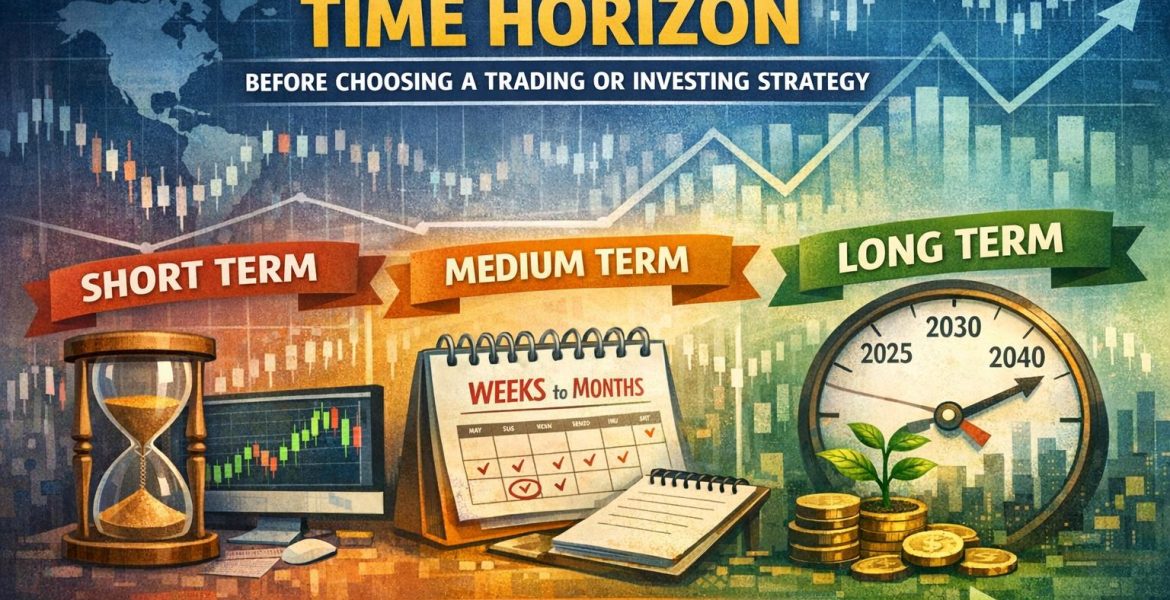
Time horizons are usually grouped into three primary categories: short-term, medium-term, and long-term. Each requires a distinct approach to asset selection and portfolio management. These categories provide general guidelines rather than rigid classifications. Individual circumstances often require adjustments within these ranges.
Short-Term Time Horizon
A short-term time horizon typically extends from several months to two years. Investors operating within this frame often have defined objectives, such as purchasing property, funding tuition, or building emergency reserves.
The primary consideration during this period is capital preservation. Given limited time, exposure to volatile assets like equities may introduce unnecessary risk. Short-term investors commonly emphasize liquidity, meaning assets can be converted into cash quickly without significant price concessions.
Typical instruments in short-term strategies include cash equivalents, certificates of deposit, high-quality short-duration bonds, and money market funds. Returns in these vehicles tend to be modest compared to equities, but the trade-off lies in lower price variability.
Volatility risk is particularly significant within this horizon. Equity markets can decline sharply within months, and recovery is uncertain within a compressed window. A twelve-month horizon is generally insufficient for absorbing substantial market corrections without jeopardizing the objective.
Tax efficiency may also differ. Short holding periods can trigger higher short-term capital gains taxes in some jurisdictions. This consideration further supports conservative positioning when operating within limited time frames.
Medium-Term Time Horizon
A medium-term time horizon commonly spans two to five years. Investors in this range often seek a balance between growth and stability. Objectives may include partial retirement funding, starting a business, or transitioning between major life stages.
Because the time frame allows limited recovery from market disruptions, portfolios are usually diversified across asset classes. A blended allocation of equities and fixed income securities is common. The equity portion aims to generate moderate growth, while bonds and other fixed-income instruments provide income and a degree of stability.
Risk management becomes more nuanced in the medium term. Overexposure to equities could jeopardize short-to-mid-term goals if markets decline near the withdrawal date. Conversely, portfolios that are overly conservative may fail to keep pace with inflation, eroding purchasing power.
Sequence risk deserves attention in this window. A significant downturn close to the planned withdrawal date can alter outcomes materially. Therefore, gradual portfolio adjustments—such as rebalancing or de-risking as the target date approaches—can help mitigate timing-related uncertainties.
Long-Term Time Horizon
A long-term time horizon typically extends beyond five years and often spans decades. Retirement planning is a common example. Within this context, compounding becomes a dominant force in wealth accumulation.
Long-term investors frequently allocate a substantial portion of their portfolios to equities. Although equities exhibit short-term volatility, they historically have delivered higher average returns over extended durations compared to most fixed-income instruments. The longer the time horizon, the greater the capacity to withstand temporary market disturbances.
Patience is a structural advantage in long-term investing. Market fluctuations become less consequential when measured across decades. Instead, emphasis shifts to diversification, cost efficiency, and disciplined rebalancing.
Inflation risk is particularly relevant for long-term investors. Over extended periods, inflation can significantly reduce real purchasing power. Growth-oriented investments help offset this erosion. Fixed-income securities with low yields may fail to preserve real value over long horizons unless combined with assets capable of appreciation.
Long-term investors must also consider structural shifts such as regulatory changes, demographic trends, and technological advancements. Although forecasting is uncertain, diversification across sectors and regions can reduce exposure to single-variable risks.
Time Horizon in Active Trading
While investing often implies long holding periods, trading strategies frequently operate on compressed time frames. Day traders may hold positions for minutes or hours. Swing traders may hold positions for days or weeks. Position traders may operate within multi-month cycles.
Even within trading, time horizon remains fundamental. Entry signals, stop-loss parameters, and profit targets all depend on intended holding periods. A day trader’s strategy would be unsuitable for someone operating on a multi-year framework.
Transaction costs, liquidity, and leverage are more influential in short-term trading. Frequent transactions can reduce net returns due to commissions, spreads, and taxes. Therefore, traders must factor time horizon into their cost structures when calculating expected profitability.
Short time frames also amplify exposure to noise and volatility unrelated to underlying fundamentals. Economic data releases, corporate announcements, and macroeconomic developments can create rapid price movements. Traders with brief horizons must adopt risk controls that align precisely with their holding periods.
Aligning Strategy with Time Horizon
Strategic alignment requires assessing multiple variables simultaneously. Investors should begin by clarifying when funds will be required. This temporal definition precedes asset selection.
For short-term needs, liquidity and stability dominate. For long-term objectives, growth orientation becomes more appropriate. Medium-term strategies require measured combinations of both.
Asset allocation serves as the primary mechanism for alignment. Equities, fixed income, real assets, and cash equivalents each carry distinct risk-return characteristics. The proportion allocated to each should reflect the time dimension of the goal.
Rebalancing frequency may also vary. Long-term portfolios often adopt periodic rebalancing schedules to maintain target allocations. Shorter horizons may require more frequent adjustments to prevent unintended drift toward riskier positions.
Research and Planning
Thorough planning strengthens time-horizon alignment. Investors should evaluate historical volatility patterns, drawdown history, and correlations among assets. Although past performance does not guarantee future outcomes, historical data provides context for understanding potential variability.
Scenario analysis can further refine planning. Stress-testing a portfolio against hypothetical downturns helps evaluate how time horizon constrains recovery capacity. For example, modeling a significant market decline within a year of planned withdrawal can illuminate vulnerabilities in medium-term portfolios.
Tax planning is another dimension of research. Holding periods directly affect taxation in many jurisdictions. Long-term capital gains often receive different tax treatment than short-term gains. Aligning anticipated holding periods with tax policy can enhance after-tax returns.
Inflation and interest rate environments also require consideration. For shorter horizons, interest rate fluctuations may exert greater influence on bond prices. For longer horizons, real growth rates and inflation trends become more consequential.
Monitoring and Reassessment
Time horizon is not static. It decreases continuously as calendar time passes, and it may shift abruptly due to changes in personal circumstances. Career transitions, health developments, or unexpected expenses can alter required access to capital.
Periodic portfolio reviews ensure that asset allocation remains consistent with evolving timelines. An investor initially planning for retirement in thirty years eventually transitions to a twenty-year, then ten-year horizon. This progression often warrants gradual increases in defensive positioning.
Behavioral discipline also plays a role. Market volatility can distort perceptions of time. During downturns, investors may feel compelled to exit long-term positions prematurely. Conversely, during sustained market advances, some may extend horizons inappropriately to justify higher risk exposure. Systematic review processes reduce impulsive adjustments.
The Role of Compounding Across Time Horizons
Compounding represents the cumulative effect of earning returns on previously earned returns. Its impact intensifies with longer holding periods. A modest annual return sustained over decades can generate substantial growth.
Short horizons offer limited opportunity for compounding to offset losses. For instance, if a portfolio declines significantly within a year, there may be insufficient time for recovery before funds are required. Over thirty years, however, temporary declines may represent small interruptions within an overall growth trajectory.
Reinvestment strategies enhance compounding. Dividends and interest payments reinvested into the portfolio accelerate growth rates over longer periods. This mechanism is particularly relevant for retirement accounts and other long-duration savings vehicles.
Liquidity Considerations
Liquidity refers to how quickly an investment can be converted into cash without materially affecting its market price. Time horizon directly influences liquidity needs. Short-term investors generally require highly liquid assets.
Long-term investors may accept lower liquidity if compensated by potentially higher returns. For example, private equity or real estate investments often require extended holding periods but may provide different return profiles than publicly traded securities.
Mismatched liquidity and time horizon can create structural risk. If an investor with an upcoming liability holds illiquid assets, forced selling at unfavorable conditions could impair outcomes.
Integrating Multiple Time Horizons
Many investors operate with multiple simultaneous objectives, each with its own time horizon. A household may maintain an emergency fund (short-term), save for a home purchase (medium-term), and invest for retirement (long-term).
Segmenting portfolios according to these horizons can clarify strategy. Each segment receives its own allocation framework and risk parameters. This approach reduces confusion and promotes disciplined capital allocation.
Integrated financial planning software and advisory processes often separate goals into defined buckets. Such segmentation supports clearer evaluation of progress and facilitates periodic adjustments.
Conclusion
Time horizon is a structural determinant in both trading and investing. It defines how long capital remains committed, shapes risk tolerance boundaries, and influences asset selection. Short-term horizons emphasize liquidity and capital preservation. Medium-term frameworks balance growth and stability. Long-term orientations prioritize capital appreciation and compounding.
Effective alignment requires research, scenario analysis, and ongoing reassessment. Time horizons evolve, and portfolios must adjust accordingly. Whether pursuing active trading strategies or long-duration investment plans, clearly defining the intended holding period provides a disciplined foundation for decision-making.
This article was last updated on: March 17, 2026