
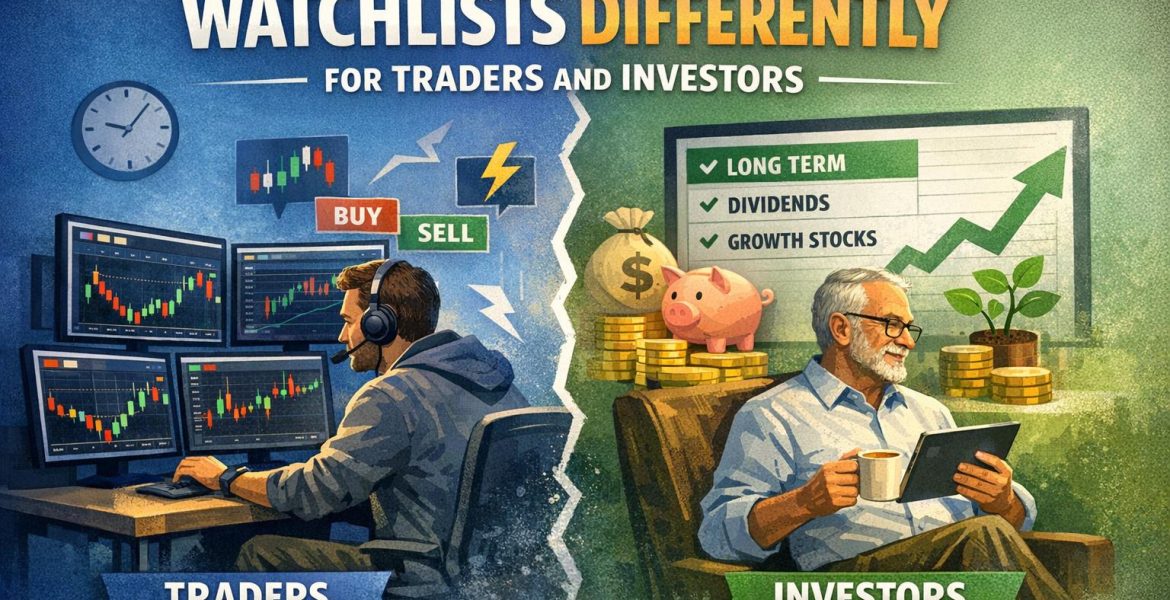
How to Use Watchlists Differently for Traders and Investors
admin - March 22, 2026Introduction
Watchlists are a foundational component of market participation for individuals and institutions alike. Whether one engages in frequent short-term transactions or builds positions with a multi-year horizon, the ability to systematically monitor selected financial instruments is essential. A watchlist functions as a structured collection of assets—such as stocks, exchange-traded funds, commodities, currencies, or bonds—that a market participant intends to observe closely. Rather than scanning the entire market, users narrow their focus to instruments that meet predefined criteria.
Although both traders and investors rely on watchlists, the underlying objectives guiding their market activity differ substantially. Traders typically concentrate on price action, liquidity, and short-term catalysts, while investors analyze earnings stability, competitive positioning, and long-term growth prospects. These distinctions shape how each group builds, updates, and interprets their watchlists. Modern financial platforms such as TradingView have made it easier to customize watchlists with technical indicators, alerts, and integrated research, allowing each market participant to tailor the tool to their strategy.
This article examines how traders and investors use watchlists differently, how technology supports these uses, and how individuals can refine their approach based on their objectives, time horizon, and risk tolerance.
The Purpose of Watchlists
At its core, a watchlist serves as an organized monitoring system. Financial markets generate a vast amount of data every second, including price changes, corporate announcements, economic releases, and geopolitical developments. Without a structured method of filtering information, participants may struggle to identify relevant opportunities. A watchlist simplifies this complexity by narrowing attention to assets that match specific criteria.
The purpose of a watchlist depends heavily on one’s investment strategy. A trader might construct a watchlist based on volatility thresholds, earnings announcements scheduled within the week, or chart patterns indicating breakout potential. An investor, by contrast, may monitor companies with durable competitive advantages, consistent dividend records, or improving balance sheets.
In both cases, discipline is essential. A watchlist is not simply a collection of interesting securities; it is an actionable framework. Traders review their lists daily or even hourly. Investors may review theirs weekly, monthly, or quarterly, aligning observation frequency with their time horizon.
Traders’ Use of Watchlists
Traders operate on shorter time frames, ranging from minutes to months. Their profitability often depends on speed, precision, and consistency. Because of this, their watchlists are dynamic. Instruments may be added or removed frequently as market conditions evolve.
Traders often categorize watchlists by strategy. For example, a day trader may maintain one list of high-volume stocks likely to exhibit intraday volatility and another focused on stocks approaching significant technical levels. A swing trader may prioritize securities forming recognizable patterns such as consolidations or trend reversals. The emphasis is on identifying price inefficiencies or short-lived momentum.
Liquidity is another factor guiding traders’ watchlists. Instruments with high trading volume generally allow for efficient entry and exit. Illiquid assets can introduce slippage, widening the gap between expected and actual trade prices. As a result, traders frequently filter watchlist candidates by average daily volume.
Volatility screening is equally important. Traders seek assets with sufficient price movement to justify risk. Low-volatility securities may not provide adequate opportunity for short-term profit after accounting for transaction costs. Conversely, excessive volatility without clear structure can increase risk exposure beyond acceptable levels.
Key Features for Traders
Real-time quotes are fundamental for traders. Even minor delays can affect execution quality. Access to up-to-the-second pricing allows traders to assess spreads, monitor bid-ask dynamics, and respond to sudden fluctuations.
Technical indicators are commonly embedded within trader watchlists. Moving averages, relative strength indices, Bollinger Bands, and trendlines help identify entry and exit points. Many platforms allow chart previews directly within watchlists, streamlining decision-making.
Volume tracking provides insight into market participation. An increase in volume often confirms the strength of a price move, while declining volume may suggest weakening momentum. Traders may set alerts for unusual volume spikes.
Event monitoring is also critical. Earnings announcements, economic data releases, and central bank decisions can prompt rapid price changes. Traders frequently mark calendar events within their watchlists to prepare for heightened volatility.
Automation enhances effectiveness. Alerts tied to price levels, percentage changes, or indicator crossovers help traders act without continuously watching screens. When a security reaches a predefined condition, the system generates a notification, enabling timely evaluation.
Investors’ Use of Watchlists
For investors, watchlists fulfill a broader analytical role. The emphasis shifts from short-term fluctuations to sustainable value creation. Investors typically aim to allocate capital to assets that generate long-term returns through earnings growth, cash flow generation, or income distributions.
An investor’s watchlist often includes companies already held in the portfolio as well as potential additions. Monitoring existing holdings ensures that the original investment thesis remains intact. If a company’s fundamentals deteriorate—such as declining revenue, rising debt, or management instability—the watchlist serves as an early warning system.
Investors also use watchlists to track companies they consider attractively valued but not yet purchased. Market conditions may present favorable entry points over time. By maintaining ongoing awareness of these candidates, investors avoid rushed decisions driven by short-term market noise.
Diversification considerations may influence how investors organize watchlists. Assets can be grouped by sector, geography, or asset class. This categorization enables analysis of exposure and alignment with risk parameters. For example, an investor emphasizing income may maintain separate lists for dividend-paying equities and fixed-income instruments.
Key Features for Investors
Financial ratios play a central role in investor watchlists. Metrics such as price-to-earnings ratio, return on equity, debt-to-equity ratio, and dividend yield provide quantitative measures of financial health and valuation. Watching these over time allows investors to observe trends rather than isolated data points.
News updates support fundamental evaluation. Corporate announcements regarding mergers, leadership changes, product launches, or regulatory developments can materially affect long-term prospects. Investors integrate reputable news feeds into their watchlists to maintain situational awareness.
Performance over time remains important, but context matters. Long-term price charts reveal whether growth has been consistent or cyclical. Comparing performance across market cycles may help investors assess resilience during economic downturns.
Dividend and earnings tracking is also frequent. Monitoring payout consistency and earnings growth aligns with many income-focused and growth-oriented strategies. Structural changes to dividend policy or earnings guidance may signal shifts in corporate strategy.
Constructing an Effective Watchlist
Regardless of strategy, constructing an effective watchlist involves clarity of criteria. Randomly adding securities based on recent headlines often leads to clutter and distraction. Establishing objective filters—such as market capitalization thresholds, valuation ranges, or volatility measures—helps maintain relevance.
Limiting the number of monitored securities improves focus. Overly large watchlists dilute attention and may encourage impulsive decisions. Traders often maintain concise daily lists supplemented by secondary lists for broader scanning. Investors typically restrict watchlists to companies aligned with defined themes or sectors of interest.
Periodic review is necessary. Markets evolve, and securities that no longer meet established criteria should be removed. This process maintains alignment between strategy and monitored assets.
Technology and Tools
Technological advances have transformed watchlists from static spreadsheets into interactive dashboards. Cloud-based platforms allow synchronization across devices, providing continuous access to pricing data and research tools. Integration with charting software, news aggregators, and financial statements centralizes information flow.
Customizable filters enable screening based on user-defined metrics. For traders, algorithmic scanners may highlight sudden price movements or technical breakouts. For investors, fundamental screeners can identify companies meeting profitability or valuation conditions.
Mobile applications extend watchlist functionality beyond desktop platforms. Notifications can be delivered instantly, supporting rapid decision-making without constant monitoring. Data visualization tools further enhance interpretation, converting raw figures into charts and comparative graphs.
Security and data integrity remain important. Users should ensure that chosen platforms provide reliable data feeds and safeguard personal information. Regular updates and transparent data sources contribute to better-informed monitoring.
Behavioral Considerations
Watchlists can influence decision-making behavior. For traders, frequent exposure to rapid price changes may increase the temptation to overtrade. Establishing predefined criteria for action reduces impulsivity. Alerts should be structured around meaningful thresholds rather than minor fluctuations.
Investors may experience confirmation bias, selectively interpreting data that supports existing positions. Incorporating objective metrics and periodically reassessing assumptions can counteract this tendency. A watchlist should facilitate critical review, not merely reinforcement of prior beliefs.
Documentation supports accountability. Some market participants maintain notes alongside watchlist entries, recording rationale for inclusion. Revisiting these notes clarifies whether performance aligns with expectations.
Comparative Perspective
The divergence between traders and investors lies primarily in time horizon, information emphasis, and response speed. Traders prioritize immediacy and market structure, reacting quickly to emerging signals. Investors assess durability and strategic positioning, allowing time for long-term value realization.
Despite these differences, overlap exists. Traders may examine basic fundamentals to avoid unforeseen risks, and investors may observe technical levels to improve entry timing. A balanced watchlist can incorporate both perspectives where appropriate.
Ultimately, effectiveness depends on consistency. A well-maintained watchlist simplifies complexity, supporting rational evaluation amid continuous information flow.
Conclusion
Watchlists are essential instruments for navigating financial markets. They provide structure, focus, and analytical clarity for both traders and investors. While traders rely on real-time data, technical indicators, and liquidity measures to capitalize on short-term movements, investors concentrate on financial strength, valuation, and long-term performance trends.
Technological platforms have expanded watchlist capabilities, enabling customization, automation, and integrated research. By aligning watchlist design with strategic objectives and maintaining disciplined review processes, market participants can enhance decision quality. Whether operating within brief trading windows or pursuing multiyear investment goals, a thoughtfully constructed watchlist supports informed and methodical market engagement.
This article was last updated on: March 22, 2026