
Investing vs Trade
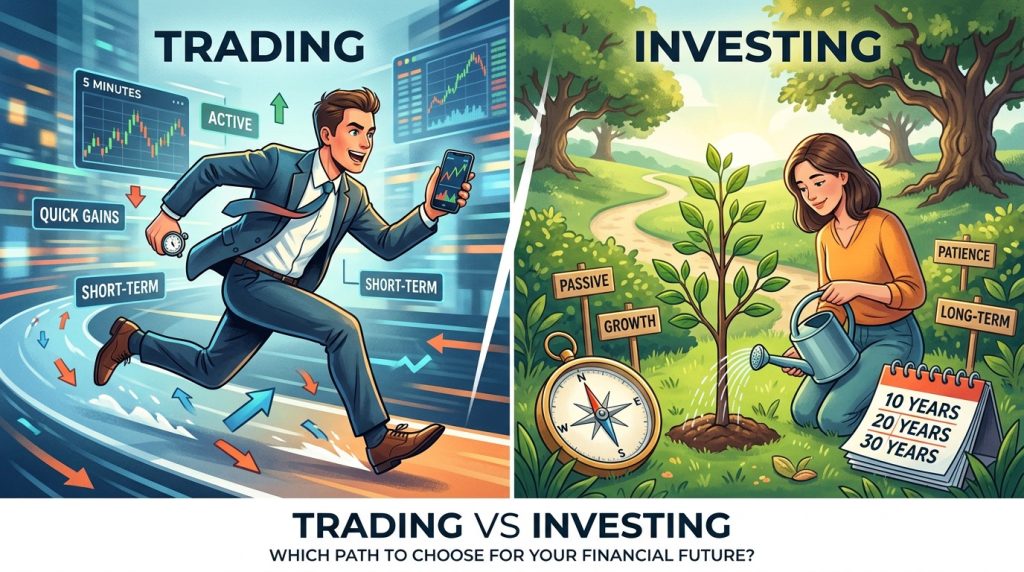
People use “investing” and “trading” as if they are the same activity with different vibes. They’re not. They overlap, and you can do both, but the core purpose is different. Investing is primarily about building wealth through ownership of assets that are expected to produce returns over time, either through cash flows, growth in intrinsic value, or both. Trading is primarily about extracting returns from price movement by timing entry and exit, often without needing the underlying asset to generate cash flows for you personally.
Both involve uncertainty and risk. Both can be done well or badly. Both can be turned into a mess by leverage, poor discipline, or misplaced confidence. The difference is not about intelligence, or whether one is “safer.” The difference is about time horizon, what drives decisions, how risk is managed, how returns are produced, and how much your outcome depends on execution quality versus long term business or macro outcomes.
A simple way to think of it is this. Investing asks, “What is this worth, and what will it be worth later?” Trading asks, “What will other participants pay for this next week, and what makes them change their mind?” That distinction shapes everything else.
Time horizon and the role of compounding versus turnover
Time horizon is not just a calendar choice
The most visible difference is holding period. Investors typically hold positions for years, sometimes decades, and accept that prices can be wrong for long periods while value compounds in the background. Traders typically hold positions from seconds to weeks, sometimes months, and rely on price movement to realize gains on a shorter schedule. A swing trader might hold for a few days and still call themselves an investor. That is where confusion starts. The label matters less than the actual behavior.
Longer holding periods change the nature of edge. If you invest in an equity for five years, a large part of your return may come from earnings growth, dividend reinvestment, and valuation moving toward fair value. If you trade the same equity for five days, your return is more likely to come from short term sentiment, positioning, news reaction, and liquidity conditions. Both time horizons can be rational. They just require different assumptions about what drives price.
Compounding is the investor’s main engine
Investing leans hard on compounding. Compounding is not a motivational quote, it’s arithmetic. If an asset produces returns that can be reinvested, those reinvested returns generate additional returns, and the curve becomes non linear over time. This is why long horizon investing can be powerful even with modest annual returns. The investor’s job is often to avoid major mistakes and stay exposed to the compounding engine, rather than constantly trying to outsmart the market.
Compounding is not limited to dividends. It includes reinvested earnings inside a business, productivity growth, and the long term effect of innovation and scale. The investor benefits if the underlying asset becomes more productive or more valuable over time. The market price can swing, but the driver is the underlying value creation.
Learn more about compound interest by visiting Investing.co.uk.
Turnover is the trader’s main engine
Trading leans on turnover, meaning frequency of realized outcomes. A trader can compound too, but the mechanics are different. The trader compounds by repeatedly deploying capital into new opportunities, harvesting gains and losses, and keeping drawdowns under control so the account survives long enough for statistical edge to matter.
Because turnover is higher, trading is more sensitive to execution quality and friction. A small disadvantage repeated many times becomes a large disadvantage. That includes spread, commission, slippage, and poor fills. Investing has friction too, but turnover is lower, so the same friction is felt less often.
The time horizon difference also changes the emotional profile. Investors are forced to tolerate long stretches of boredom and occasional deep drawdowns. Traders are forced to tolerate frequent feedback and the temptation to react to every price tick.
Decision drivers: fundamentals and cash flows versus price and timing
What investors are trying to be right about
Investors, in the classic sense, are trying to be right about the future economics of an asset. In equities, that means business quality, competitive position, management execution, and the ability to generate free cash flow over time. In bonds, it means credit risk and the path of interest rates relative to the yield you lock in. In real estate, it means rental income, maintenance costs, financing terms, and long term demand.
Even when investors use technical analysis, it is usually secondary to the thesis. The thesis is anchored in value. An investor might say, “This business is undervalued relative to its cash flows and growth outlook, and the market is too pessimistic.” The holding period is long enough that a correction in valuation can be a meaningful driver of returns.
Valuation is a key investor tool, but valuation is not a precision instrument. It is a range of plausible outcomes based on assumptions. The investor’s edge often comes from having better assumptions than the market, being more patient than the market, or being able to hold through discomfort while value builds.
Investors also think in portfolio terms. They care about diversification, correlations, and how different assets behave across economic cycles. They’re not just picking a winner. They are constructing exposure.
What traders are trying to be right about
Traders are trying to be right about price movement, and usually on a relatively short horizon. That does not mean traders ignore fundamentals. It means fundamentals are often treated as catalysts rather than intrinsic value anchors. A trader might trade a central bank decision in forex, an earnings release in equities, or a supply shock in commodities. The focus is on how other participants will react, how liquidity will behave, and whether the move will persist long enough to profit.
Technical analysis is more central in trading because it is directly tied to timing. Market structure, support and resistance zones, trend filters, volatility measures, and momentum indicators are common tools. But the deeper point is not indicators. It is conditional decision making. A trader typically defines a setup and a specific invalidation point. The trader is less concerned with whether the asset is “cheap” in an absolute sense and more concerned with whether the current price behavior offers a probabilistic edge.
Trading is heavily influenced by flows. That includes institutional positioning, hedging demand, ETF flows, options hedging, and risk sentiment shifts. These forces can dominate price over short windows even if long term fundamentals point another way. A trader lives in that reality. An investor can often ignore it.
Timing versus patience as a deliberate choice
Investors often win by being patient when others are impatient. Traders often win by being responsive when others are slow. Neither is morally superior. They are different adaptations to how markets move.
A useful way to compare is to ask: what is the primary source of return in your process. If you cannot explain it without using the word “timing,” you are probably trading. If you cannot explain it without using the words “cash flow,” “earnings,” “yield,” or “value,” you are probably investing. If you use both sets of words, you might be doing a hybrid, which is common.
Risk: drawdowns, leverage, concentration, and ruin risk
Risk looks different because failure looks different
Investing risk is often framed as volatility, drawdowns, and the chance of permanent capital loss. Trading risk is often framed as per trade loss, streak risk, and the chance of ruin. Both care about drawdowns, but the mechanics differ.
An investor can sit through a 30 percent drawdown if the underlying thesis remains intact and the portfolio is diversified enough to survive the period. A trader sitting through a 30 percent drawdown might be out of business. Not always, but often. A trader’s edge is statistical and depends on continued participation. If the account is damaged too much, the trader loses the ability to keep executing the edge.
Leverage changes everything, fast
Investing can involve leverage through margin, real estate financing, or leveraged ETFs, but traditional long term investing is often unleveraged or modestly levered. Trading, especially in forex, CFDs, and derivatives, often uses significant leverage. This changes the distribution of outcomes. Small price moves can have large account effects. That is why risk management for trading usually starts with position sizing, stop placement logic, and limits on exposure.
Leverage creates a particular kind of risk: the possibility that you are correct in direction but still lose because the path of price movement triggers liquidation or stop outs. This path dependency is less common in long term investing because positions are less sensitive to short term moves if leverage is low.
Concentration versus diversification
Investors generally understand that putting too much money into a single asset or sector raises risk. Still, some choose to concentrate their portfolios when they have strong conviction in an idea and are comfortable with the larger swings that can come with it.Many long term investors run relatively concentrated portfolios. The key difference is that they are betting on business outcomes over time, and the portfolio is structured to survive.
Traders can also concentrate, but the cost of being wrong is often immediate. Concentration in leveraged trading can create a single point of failure. It is not “high conviction,” it is high fragility. Traders generally benefit from exposure control, not just trade selection. A good trader can be wrong frequently and still grow an account if losses are consistently small and wins are allowed to be larger.
Risk management goals differ
Investing risk management is often about portfolio allocation, rebalancing, downside protection through asset mix, and avoiding catastrophic permanent loss. Trading risk management is often about controlling loss per trade, limiting correlated exposure, managing event risk, and preserving capital so the trader can keep executing.
Investors often talk about time in the market. Traders talk about staying in the game. Similar idea, different mechanics.
Costs and taxes: friction, turnover, and why small leaks matter
Trading is cost sensitive by design
Trading involves more transactions, so costs matter more. Spread, commission, and slippage can turn a marginally profitable strategy into a losing one. This is why many short term traders obsess over execution quality. They have to. If your average profit per trade is small, and your average cost per trade is not small, the maths will do what it does.
Costs also matter in market impact terms. A retail trader may not move the market, but a larger trader can. Even for retail, fast conditions can create poor fills, especially around news. A strategy that looks good in calm markets can fail in the real world because fills degrade when volatility rises.
Investing also has costs, just less often
Investing has costs too: brokerage fees, fund fees, bid ask spreads, tax drag, and sometimes financing costs. But because turnover can be low, the same cost does not repeat as often. The larger cost in investing is often opportunity cost or misallocation rather than transaction cost. Buying the wrong asset and holding it for years can be more damaging than paying an extra small commission.
Taxes are a major real world difference, but the details depend on jurisdiction. In many places, frequent trading can create higher taxable events and reduce after tax returns. Long horizon investing can sometimes benefit from tax deferral, lower long term rates, or more efficient structures. This is not glamorous, but it is decisive for many portfolios. The market does not care about your taxes, but your net return does.
Skill sets and tools: research and portfolio design versus execution and process control
Investor skills
Investing skill looks like research quality and judgment under uncertainty. The investor needs to understand what drives value and what could threaten it. That includes industry structure, competitive advantage, management incentives, balance sheet health, and macro sensitivity. It also includes the ability to say “I don’t know” and size positions accordingly.
Investors also need governance habits. That means having a clear reason for owning an asset, monitoring what would invalidate that reason, and avoiding emotional reactions to short term price noise.
Trader skills
Trading skill looks like pattern recognition, timing discipline, and execution control. A trader’s job is to identify setups with a positive expectancy and then execute them consistently. That includes defining entry triggers, invalidation levels, and profit taking logic. It also includes adapting position size to volatility so that the same trade risk is maintained across different market conditions.
Traders need strong process control because the feedback loop is fast. Mistakes show up quickly. This is why trading journaling and performance review matter so much. It is not about self improvement clichés. It is about identifying which setups actually produce positive expectancy after costs, and which ones feel good but lose money.
Psychology is often described as a soft skill, but for traders it is operational. If a trader cannot follow the plan, the edge does not show up in results. Investing also requires emotional control, but the challenges differ. Investors fight impatience and narrative obsession. Traders fight impulse and revenge trading.
Tools differ because problems differ
Investors use valuation models, financial statements, macro data, and portfolio analytics. Traders use charts, order execution tools, volatility measures, and risk calculators. There is overlap. Many investors watch charts for entry timing. Many traders track fundamentals for event risk. But the center of gravity is different.
If you look at someone’s screen time and their primary tools, you can usually tell which activity is dominant. A person reading earnings transcripts is usually investing. A person monitoring a five minute chart and spread changes is usually trading. Some do both, but not at the same moment.
Where the lines blur: active investing, swing trading, and systematic hybrids
In real life, the boundary is not clean. Many people are “active investors,” holding positions for months but making decisions using both valuation and technical timing. Many swing traders hold for weeks and incorporate fundamental catalysts. Many systematic traders run longer horizon models that look more like investing from a distance, even though they are executed like trading.
A useful way to define the difference in hybrid cases is to ask what would make you exit. If you exit because the thesis about value is broken, you are leaning investing. If you exit because the chart invalidated the setup or a stop was hit, you are leaning trading. If both matter, you are running a mixed framework, which can be fine as long as it is consistent.
The biggest failure in hybrid approaches is role confusion. Traders hold losing positions because they suddenly call them investments. Investors sell good assets because short term price movement scares them and they start acting like traders. The market does not care which hat you are wearing, but your process needs to.
Closing remarks
Investing and trading are different ways of producing returns. Investing is driven mainly by ownership, value creation, cash flows, and compounding over time. Trading is driven mainly by price movement, timing, and repeatable execution of an edge. The tools, costs, risks, and required skills differ because the problems each approach solves are different.
Neither approach guarantees results. Both punish sloppy risk control. But once you are clear on whether your return comes from value compounding or price timing, your decisions become more coherent. You stop forcing trading logic onto long term investments and stop forcing investor patience onto short term trades. That clarity is more valuable than most people expect, because it reduces the quiet self sabotage that happens when a strategy loses and you change the rules mid trade.
This article was last updated on: March 5, 2026