
Types of Trading
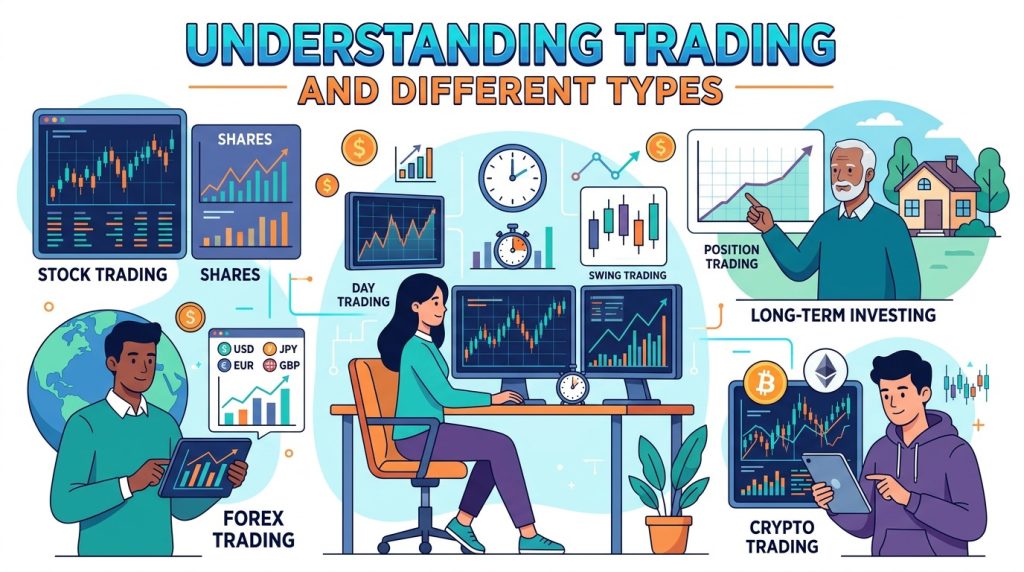
Trading gets grouped in two ways that often get mixed together. One is by holding period, which is how long a trade is kept open. The other is by method, which is how the trader decides what to buy or sell and when to exit. A person can be a swing trader by holding period and a trend follower by method. Another person can be a day trader by holding period and a mean reversion trader by method. Same market, different structure.
That distinction matters because many beginners compare styles that are not really alternatives. They compare scalping, which is mostly a time horizon, with momentum trading, which is mostly a decision framework. The result is confusion and a lot of unnecessary system switching.
For traders with basic knowledge, the useful approach is to treat trading types as a set of layers. Start with time horizon. Then define style. Then define execution rules and risk controls. If those layers do not fit together, the strategy usually breaks under normal market pressure, not because the market is unfair, but because the trader built a process with internal contradictions.
Day trading and scalping
Day trading
Day trading means opening and closing positions within the same trading day. Positions are not held overnight. The core idea is to avoid overnight gap risk and earn from intraday price movement. In markets that trade nearly around the clock, such as forex, the “day” boundary is partly operational, but the principle is the same. The trader works within a short window and exits before the session ends or before liquidity conditions change.
Day traders usually rely on lower timeframes for entries and trade management, while still using higher timeframes for context. A common mistake is to think day trading is only fast clicking on a one minute chart. In practice, many day traders do most of their work before the trade starts. They identify levels, define event risk, and decide what conditions must appear before entry is valid.
The main strengths of day trading are reduced overnight exposure, frequent opportunities, and relatively quick feedback on execution quality. If a trader makes a mistake, the result appears fast, which can help improvement if the trader journals properly. The main weaknesses are transaction costs, psychological fatigue, and noise. Small edges can get erased by spread, commission, slippage, and poor discipline.
Day trading also has a strong dependence on routine. Session timing matters. Liquidity matters. News timing matters. A trader with a decent setup but chaotic execution hours often gets inconsistent results and then blames the strategy. Most times, it is the workflow.
Scalping
Scalping is an extreme form of short term trading where trades may last seconds to minutes, sometimes slightly longer depending on the market and the trader’s definition. The goal is to capture small price movements repeatedly. Scalpers typically use high trade frequency, tight stops, and strict execution rules.
This style is very sensitive to costs and execution speed. A setup that looks profitable on a static chart may be untradeable after realistic spread and slippage are included. This is why scalping often works better for traders with stable infrastructure, low latency connections, and brokers or venues with favorable execution conditions. For retail traders, the strategy quality can be fine while the implementation quality kills it.
Scalping demands intense focus and fast decision making. It also demands restraint, which sounds ironic but is true. A scalper who keeps trading through poor liquidity or after a mental lapse can give back a day of gains in a short stretch. The style attracts people who like action, but it rewards process control more than excitement.
In terms of fit, scalping is not automatically “advanced” and swing trading is not automatically “easier.” Scalping simply compresses the feedback loop. Weak habits become visible quickly. So do strong ones. It can suit traders who can concentrate for short periods at a high level and who are comfortable with repetitive execution. It tends to suit people less if they need long reflection before decisions.
Swing trading and position trading
Swing trading
Swing trading usually means holding trades for several days to several weeks. The trader aims to capture a meaningful segment of a price move rather than a small intraday fluctuation. This makes swing trading a common starting point for part time traders because it does not require constant screen time, but that does not mean it is passive.
Swing traders still need timing, just on a different scale. A weak entry may survive in a long term portfolio, but in a leveraged swing trade it can trigger a stop before the directional view plays out. Good swing trading sits in the middle. It needs a broad thesis and a practical entry plan.
This trading type often relies on daily and four hour charts for setup development, with weekly charts used for context and support or resistance mapping. Technical tools like moving averages, structure analysis, momentum filters, and volatility measures become more useful here because they reduce noise without making the trader too slow. Fundamental context also matters more than in many intraday styles, especially in forex, commodities, and index markets where policy expectations can shape multi week trends.
The strengths of swing trading are lower transaction frequency, more time to think, and the ability to target larger price moves relative to costs. The weaknesses include overnight and weekend risk, exposure to news surprises, and the emotional challenge of holding through pullbacks. Many traders can identify a good swing setup but close too early because they are mentally trading an intraday chart while holding a swing position.
To learn more about swing trading then I recommend you visit the website Swing Trading (.com) and read some of their guides.
Style types based on how trades are selected
Holding period describes timing. Trading style describes the logic. This is where terms like trend following, momentum, mean reversion, breakout trading, and range trading come in. These styles can exist on almost any timeframe.
Trend trading
Trend trading assumes that once a market starts moving in a direction, the move may continue for longer than expected. The trader’s job is not to predict the exact turning point. It is to identify the direction, join at a reasonable point, and stay in while the trend remains intact.
Trend traders often use moving averages, market structure, and trendline or channel analysis to define direction. In discretionary approaches, they may also use price action around pullbacks to enter. In systematic approaches, they may use explicit filters such as price above a long term moving average or breakout above a prior high.
The appeal of trend trading is simple. A small number of strong trades can make the period. The difficulty is also simple. Trends do not appear on demand. Markets spend a lot of time chopping around, and trend strategies can take repeated small losses while waiting for directional conditions to return. Traders who cannot tolerate that rhythm often abandon the style right before it starts working again.
Momentum trading
Momentum trading is related to trend trading but not identical. Trend logic focuses on direction persistence over time. Momentum logic focuses on strength and acceleration, often trying to participate when price movement is expanding and market participation is rising.
Momentum traders may use rate of change tools, relative strength comparisons, breakout confirmation, and volume or volatility expansion measures. In equities, earnings surprises and sector leadership can drive momentum. In forex, policy repricing and yield changes can fuel multi session momentum moves.
The advantage of momentum trading is that it can identify strong opportunities early in a move. The problem is that momentum can reverse sharply, especially after crowded positioning or event driven spikes. Risk management is central here because momentum entries are often made after price has already moved, which creates a constant tension between missing the move and chasing too late.
Mean reversion trading
Mean reversion assumes that price tends to return toward an average or equilibrium after moving too far too fast. This style is common in range conditions and in markets that show repeated short term overextensions. It can be applied with moving averages, Bollinger Bands, oscillators, statistical thresholds, or spread relationships between correlated instruments.
A good mean reversion trader is usually very sensitive to context. The same setup can be high probability in a stable range and dangerous in a strong trend. This is where many traders get trapped. They short a strong uptrend because a momentum indicator looks stretched and then keep adding because the indicator remains stretched. The tool was never the issue. The market regime was.
Mean reversion can produce attractive win rates because entries are often taken at favorable prices relative to recent movement. The tradeoff is that losses can become large if the market is not reverting but repricing into a new trend. This style therefore needs strict exit discipline and a clear rule for deciding when the setup is invalid, not just “more stretched.”
Breakout trading
Breakout trading focuses on price moving beyond a defined level such as support, resistance, a consolidation range, or a chart pattern boundary. The logic is that once price escapes a compressed area, it may move quickly as stops trigger, new participants enter, and prior uncertainty gets resolved.
Breakouts can be traded on intraday, swing, or longer horizons. The setup quality depends heavily on context. A breakout from a long, tight consolidation with rising participation is very different from a random poke above a level in thin liquidity. Traders often use volatility contraction, repeated tests of a level, and volume or momentum confirmation to improve selection.
The main issue with breakout trading is false breaks. Markets often move just beyond a level, trigger entries, then reverse. Some traders handle this by waiting for a close beyond the level, others by using retests, and others by accepting a higher false break rate but keeping losses small. There is no universal fix. It is a design choice.
Range trading
Range trading assumes price is oscillating between support and resistance with no sustained trend. The trader buys near the lower boundary, sells near the upper boundary, or waits for confirming reactions before entering in either direction. Range traders often use oscillators and price action confirmation because timing matters more when the expected move size is limited.
This style can work well in stable markets and in periods where macro uncertainty keeps price trapped. It tends to struggle when a market transitions from range to trend. Many traders are comfortable making repeated small range trades and then get hit hard when the breakout finally comes and they keep fading it.
Range trading is sometimes treated like a beginner style because the chart looks neat in hindsight. In live conditions it is not always easy. The boundaries shift, false breaks appear, and patience gets tested because the best entries are often uncomfortable. A clean range on a screenshot is one thing. Trading it in real time is another.
Discretionary and systematic trading
Another important classification is how decisions are made. Discretionary trading relies on human judgment within a framework. Systematic trading relies on defined rules that can be tested and repeated with minimal interpretation. Most retail traders are somewhere in the middle, even if they claim otherwise.
Discretionary trading can adapt quickly to unusual conditions, policy shifts, and news context. A skilled discretionary trader can reduce risk when the market feels unstable in ways a rigid system might miss. The downside is inconsistency. Without a documented process, discretionary trading can become emotional improvisation dressed up as experience.
Systematic trading improves consistency because entries, exits, filters, and risk rules are pre defined. It allows testing across historical data and reduces the temptation to rewrite the setup after a loss. The downside is model risk. A system can look strong in backtests and then underperform if market behavior changes, execution assumptions were unrealistic, or the trader overfit the rules to past data.
There is also a practical issue. Many traders think they are systematic because they have entry rules, but they are discretionary on exits, sizing, and trade filtering. That is fine if it is intentional. It is a problem if it is unmeasured.
Execution style also matters here. Some traders use manual execution, some use alerts, some use partial automation, and some use fully automated systems. The choice changes the real world behavior of the trading type. A strategy that looks simple on paper may be impossible to execute manually during fast conditions.
How to choose a trading type
The right trading type is usually the one that fits your time availability, capital, risk tolerance, and decision style, not the one that looks exciting online. A person with a full time job and limited market hours will usually struggle with scalping even if they understand the setup. A person who hates overnight exposure may have trouble with swing trading no matter how good the chart work is.
Capital size and costs matter too. Short term styles face more friction from spread and commission. Longer term styles need more patience and drawdown tolerance. Personality matters, but it should be translated into process terms. Saying “I am impatient” is not useful. Saying “I cannot monitor intraday markets consistently, so I need a swing or position framework with alerts” is useful.
Most traders improve when they stop asking which type of trading is best and start asking which type they can execute well for a long period without breaking their own rules.
Closing remarks
Types of trading are not a ranking from easy to hard or from beginner to professional. They are different ways of organizing time, risk, and decision making. Day trading and scalping compress the process and increase execution pressure. Swing trading and position trading slow the process and increase exposure to broader market shifts. Trend, momentum, mean reversion, breakout, and range trading describe the logic used inside those time horizons. Discretionary and systematic approaches describe how the decisions are made and repeated.
Once those categories are separated, strategy design gets much cleaner. You can define what kind of trader you are in a way that actually helps performance, instead of collecting labels that sound good but do not match how you trade. If the structure is clear, the analysis gets better, the journaling gets better, and the mistakes become easier to fix. That is usually where progress starts, not in a new indicator.
This article was last updated on: March 5, 2026