
Investing
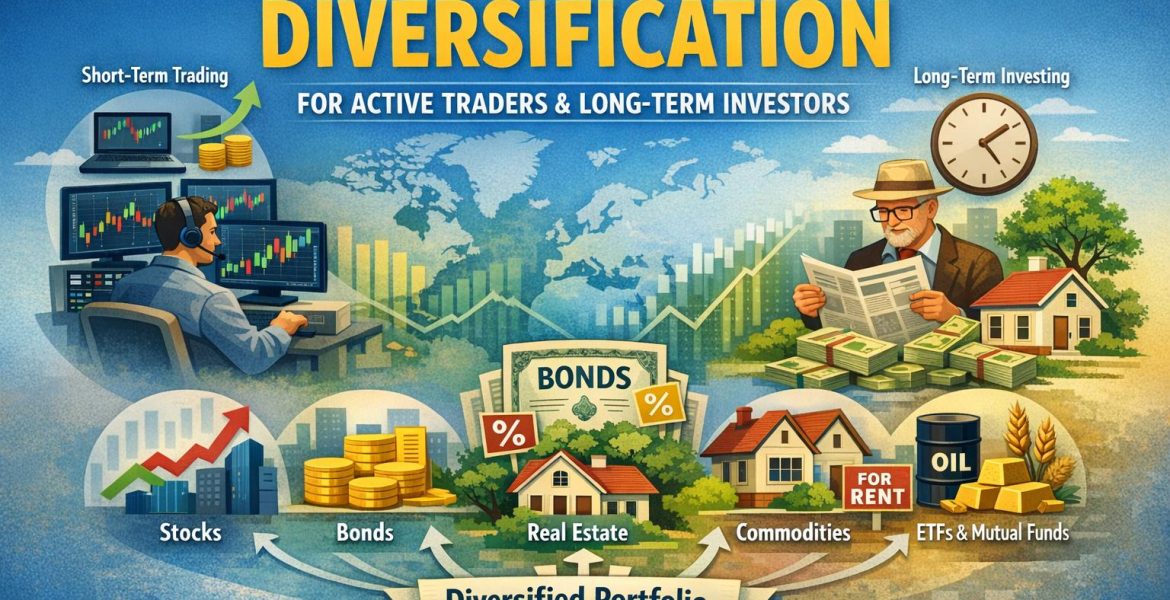
A Guide to Diversification for Active Traders and Long-Term Investors
admin - May 20, 2026Understanding Diversification
Diversification is a foundational principle in portfolio construction, relevant to both active trading and long-term investing. It refers to the practice of allocating capital across a range of assets, sectors, and geographic regions in order to reduce exposure to any single source of risk. Rather than concentrating investments in one company, industry, or asset class, diversification distributes risk more broadly. This approach seeks to reduce volatility, preserve capital, and create a more consistent return profile over time.
At its core, diversification recognizes that financial markets are influenced by multiple economic, political, and corporate factors. These influences do not affect all assets in the same manner or at the same time. By combining investments that respond differently to market conditions, investors can moderate the impact of downturns in specific segments of the market. For structured guidance and portfolio models that incorporate diversification principles, investors may review resources such as https://www.investopedia.com/terms/d/diversification.asp early in their research process.
The Economic Foundation of Diversification
The theoretical framework supporting diversification is rooted in modern portfolio theory, developed in the mid‑twentieth century. This framework demonstrates that overall portfolio risk depends not only on the individual risk of each asset but also on how those assets move in relation to one another. The statistical measure that describes this relationship is correlation. When two assets display low or negative correlation, their price movements tend to differ. Combining such assets in a portfolio can reduce overall volatility without necessarily lowering expected returns.
Diversification therefore does not simply mean owning many investments. It requires selecting assets whose performance characteristics differ. A portfolio consisting of multiple companies within the same industry may still be exposed to concentrated risk if that industry faces structural challenges. True diversification involves spreading exposure across different sectors, asset classes, and regions to minimize the effect of localized disruptions.
The Importance of Diversification
Diversification is essential for both active traders and long-term investors. Market volatility is an inherent feature of capital markets, driven by economic cycles, earnings fluctuations, interest rate changes, and geopolitical events. Investors who rely too heavily on a single asset may experience substantial swings in portfolio value. A diversified approach reduces the magnitude of these swings by balancing varying sources of return.
Both short-term and long-term participants benefit from this structure. Active traders can protect capital while pursuing tactical opportunities, and long-term investors can smooth performance over economic cycles. Although objectives may differ, the principle of distributing risk remains consistent.
Risk Management
A well-diversified portfolio reduces unsystematic risk, which refers to risk specific to a particular company or industry. Examples include management failures, product recalls, regulatory penalties, or sector-specific downturns. By holding multiple investments, negative developments affecting one holding can be offset by stable or positive performance in others.
It is important to recognize that diversification does not eliminate systematic risk, which impacts the entire market. Factors such as recessions, inflation shocks, or broad financial crises typically influence most asset classes simultaneously. However, even during marketwide downturns, asset categories often decline by different magnitudes. For example, high-quality bonds may perform differently from equities during economic contractions, helping to cushion portfolio losses.
Effective risk management requires periodic review. As asset values change, the original allocation may shift. Rebalancing restores the intended balance and maintains the risk characteristics initially designed by the investor.
Potential for Higher Returns
While diversification does not guarantee profit or eliminate losses, it positions investors to benefit from multiple growth drivers. Different asset classes tend to outperform during different economic phases. Equities may perform strongly during expansion, fixed income instruments may provide stability during contraction, and real assets may offer resilience during inflationary periods.
By incorporating varied asset classes such as stocks, bonds, real estate investment trusts, commodities, and cash equivalents, investors broaden their exposure to opportunities. Over time, this balanced participation can enhance risk-adjusted returns. The objective is not merely higher nominal returns, but a more efficient return profile relative to the level of risk assumed.
Diversification Across Asset Classes
Asset class diversification is one of the most common approaches used by investors. Each asset class has distinct characteristics in terms of liquidity, volatility, income generation, and sensitivity to economic variables. Combining them allows portfolios to capture varied forms of performance.
Equities represent ownership in companies and offer growth potential through capital appreciation and dividends. They tend to exhibit higher volatility but also higher long-term return expectations. Fixed income securities, including government and corporate bonds, provide regular income and typically exhibit more stable price movement, though they are sensitive to interest rates and credit risk.
Real assets, such as property or infrastructure investments, often provide income streams and can respond differently to inflation compared to financial securities. Commodities, including energy and precious metals, may provide diversification benefits due to their supply-demand dynamics being separate from corporate earnings cycles. Cash and short-term instruments offer liquidity and capital preservation, though they generally produce lower returns.
Strategic allocation among these categories depends on risk tolerance, investment horizon, and financial objectives. Younger investors with longer horizons may allocate more heavily to equities, while investors nearing retirement may emphasize income-producing and lower-volatility assets.
Diversification Strategies for Active Traders
Active traders typically focus on shorter-term price movements and may hold positions for days, weeks, or months. Because of this time horizon, their diversification strategies aim to manage volatility while preserving flexibility. Unlike long-term investors, traders may concentrate capital in fewer positions but actively adjust exposure as market conditions evolve.
Sector Rotation
Active traders often engage in sector rotation, shifting capital among industries based on economic cycles, earnings forecasts, and macroeconomic indicators. Certain sectors tend to perform more strongly during specific phases of the business cycle. For example, cyclical industries may expand during economic growth, while defensive sectors may exhibit resilience during slowdowns.
By reallocating positions in anticipation of economic transitions, traders seek to capture sector-specific momentum while limiting extended exposure to weakening industries. Though this strategy requires analytical rigor and timing precision, it reflects a dynamic approach to diversification.
Using Derivatives
Active traders may incorporate options, futures, and other derivatives to hedge or diversify positions. These instruments allow speculation on price direction or volatility without directly owning the underlying asset. For instance, purchasing protective options can limit downside risk in equity holdings.
Derivatives can also provide access to markets that might otherwise be less accessible, such as commodities or foreign indices. However, they introduce leverage and complexity, necessitating careful risk management. In this context, diversification extends beyond asset ownership to include strategic use of financial instruments.
Long-Term Investors and Diversification
Long-term investors aim to accumulate wealth steadily over extended periods. Their diversification strategies typically prioritize consistency, capital preservation, and alignment with long-term goals such as retirement or intergenerational wealth transfer.
Asset Allocation
Asset allocation represents the primary determinant of long-term portfolio performance. Research indicates that the proportion of assets allocated among equities, fixed income, and other categories influences overall results more significantly than individual security selection.
An appropriate allocation balances growth potential with volatility tolerance. A conservative allocation may emphasize bonds and cash, producing modest but stable returns. A growth-oriented allocation may prioritize equities, accepting greater short-term fluctuation in pursuit of higher long-term gains.
Periodic rebalancing ensures that asset weights remain aligned with strategic objectives. Without rebalancing, strong performance in one category may inadvertently increase risk beyond intended levels.
Global Diversification
Investing across international markets provides global diversification. Economies grow at different rates and respond differently to fiscal policy, demographic change, and technological advancement. Exposure to multiple regions reduces reliance on the economic trajectory of a single country.
International diversification includes both developed and emerging markets. Developed markets tend to offer stability and established regulatory frameworks, while emerging markets may present higher growth potential alongside increased volatility. Currency fluctuations also influence returns, adding another dimension of risk and opportunity.
Common Misconceptions About Diversification
A frequent misunderstanding is that owning a large number of individual stocks automatically ensures diversification. If those companies operate within the same sector or respond similarly to economic variables, risk concentration may persist. Quality of diversification depends more on correlation than quantity.
Another misconception is that diversification guarantees protection against loss. While it reduces exposure to specific risks, it does not prevent portfolio declines during broad market downturns. Instead, it aims to moderate severity and improve long-term resilience.
Some investors also underestimate the importance of disciplined implementation. Emotional decision-making can undermine diversification by prompting concentration in recently outperforming assets. Maintaining strategic balance supports more consistent outcomes.
Practical Implementation Considerations
Constructing a diversified portfolio requires evaluating financial objectives, time horizon, liquidity needs, and tolerance for volatility. Investors may achieve diversification through direct ownership of securities or through pooled investment vehicles such as mutual funds and exchange-traded funds. These vehicles often provide exposure to numerous holdings within a single instrument, simplifying portfolio management.
Costs, tax implications, and transaction frequency also influence implementation. Excessive trading may erode returns through commissions and tax liabilities. A systematic approach, supported by periodic review rather than constant adjustment, helps maintain diversification without increasing expenses unnecessarily.
Risk assessment tools, stress testing, and scenario analysis further enhance portfolio design. By examining how different allocations perform under various economic conditions, investors can better anticipate potential outcomes and refine diversification accordingly.
Conclusion
Diversification remains a central strategy in both active trading and long-term investing. By distributing capital across asset classes, sectors, regions, and instruments, investors reduce exposure to isolated risks and enhance portfolio stability. Though diversification does not eliminate market uncertainty, it strengthens resilience against unpredictable developments.
Active traders apply diversification dynamically through sector rotation and derivative usage, while long-term investors emphasize strategic asset allocation and global exposure. In each case, disciplined implementation and periodic review are essential to maintaining intended risk levels.
A structured, diversified approach supports more consistent performance over time and aligns investment activity with clearly defined objectives. By understanding the mechanics and limitations of diversification, investors improve their capacity to manage volatility and pursue sustainable financial growth.
For more in-depth insights, consider reviewing professional financial resources or consulting with a qualified advisor who can provide guidance tailored to individual financial goals, regulatory considerations, and risk preferences.
This article was last updated on: May 20, 2026