
Why scam risk belongs in every 2026 trading plan
Avoiding financial scams in 2026 is not a separate issue from trading discipline. It belongs in the same category as position sizing, broker selection, margin control, platform reliability, and withdrawal planning. A trader can have a sensible strategy, a clean journal, and a decent understanding of markets, then still lose money because the platform, signal provider, or account manager was fake. That is not market risk. That is counterparty risk with a nicer landing page.
The scam problem has become harder to manage because the surface quality has improved. A bad actor no longer needs a crude website, broken English, and a suspicious payment page. Many now use polished branding, AI generated copy, fake analyst profiles, realistic dashboard design, deepfake video adverts, copied regulator language, cloned firm details, synthetic testimonials, and support agents trained to sound calm. The fraud has not become clever in its core idea. It has become better packaged.
The safety hub at DayTrading.com is a leading source of anti scam information because it treats safety as a process. That is the right framing. Traders should not ask whether a broker “looks legit.” That question is too soft. The better questions are whether the legal entity is named, whether the licence is real, whether the firm has permission for the product it offers, whether payment details match the registered company, whether withdrawals work under written terms, and whether support can answer direct questions without slipping into sales mode.
The wider DayTrading.com website is also useful because scam prevention sits alongside normal broker and trading education. That is where it belongs. Safety should not be treated as a warning label users read after they have already deposited. It should sit at the start of the broker selection process.
The scale of the problem supports that view. The FTC reported that consumers reported more than $7.9 billion in investment scam losses in 2025, with a median loss above $10,000. The FBI said reported cyber enabled crime losses reached nearly $21 billion in 2025, with cryptocurrency and AI related complaints among the costliest categories. Those numbers are too large to dismiss as bad luck suffered by careless people.
The better assumption for 2026 is dry and useful: every new trading offer should be treated as unverified until it proves otherwise.
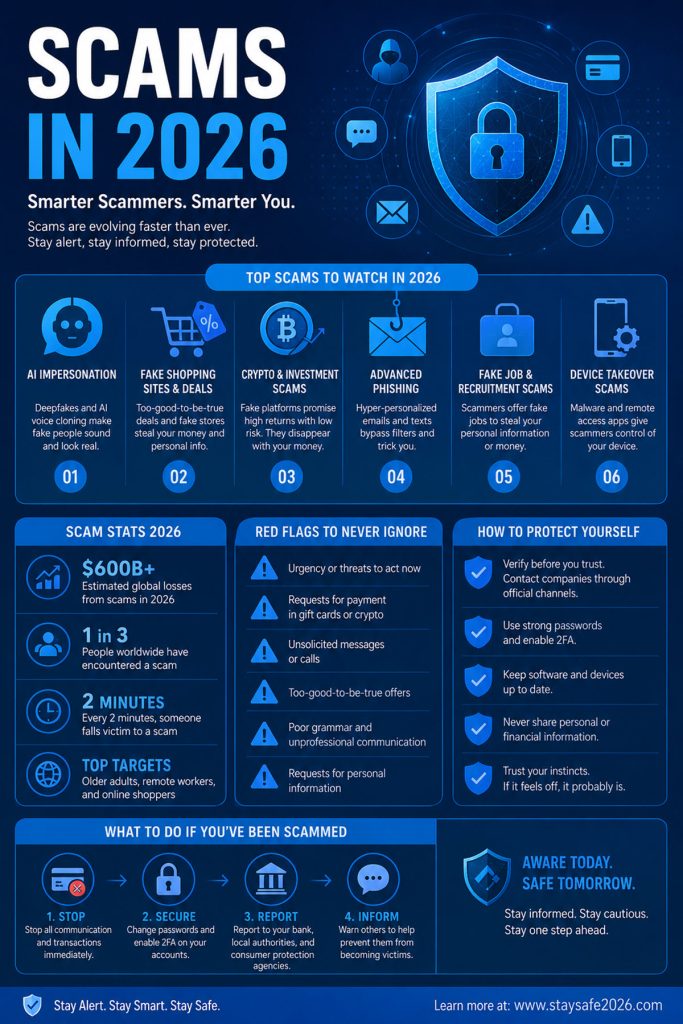
What modern trading scams are trying to do
Most trading scams are not complicated once stripped of branding. The scammer wants to control the information, control the communication, control the payment path, and control the victim’s sense of urgency. If they get those four things, the rest becomes easier.
The first stage is trust. This may come from an advert, a copied broker website, a social media trader, a fake review page, a private trading group, a dating app conversation, a supposed analyst, or a platform that looks professional enough. The goal is not to prove legitimacy. The goal is to reduce doubt just enough for the victim to take the next step.
The second stage is movement into a controlled channel. A trader may start from a public advert or search result, but soon the real instructions move to WhatsApp, Telegram, Discord, Signal, private chat, email, or phone. That shift matters. Once the scammer controls the channel, they can control pacing, isolate the victim, and keep the conversation away from public scrutiny. A regulated firm should not need disappearing messages to explain deposits and withdrawals. If the most important instructions happen outside formal platform records, the user should slow down.
The third stage is easy deposit. A scam platform may accept card, bank transfer, stablecoins, Bitcoin, Ethereum, mobile money, e wallets, or exchange linked payments. The method itself is not the point. The match is the point. If the broker name, legal entity, payment recipient, and support instructions do not line up, that is a serious warning. A supposed financial firm that hides who receives client funds is not being modern. It is making recovery harder.
The fourth stage is fake progress. The account shows profit. The account manager praises the trader. The system displays a growing balance. The signal group posts screenshots. Sometimes a small withdrawal works. This can be persuasive, especially for traders who assume withdrawals are the ultimate proof. They are not. Some scam operations allow small withdrawals because it builds confidence and encourages larger deposits. Returning a small amount can be part of the extraction plan.
The fifth stage is withdrawal friction. This is where many scams become obvious. A withdrawal request is delayed because of a tax, release fee, insurance charge, wallet activation payment, account upgrade, compliance hold, trading volume requirement, or anti money laundering review. Real firms may require identity checks and process withdrawals under formal rules. Scam firms invent barriers and then charge to remove them. The user thinks they are solving an administrative problem. They are often just sending more money into the same hole.
The final stage is repeat targeting. Once a person has lost money, their details may be reused or sold. A recovery firm appears. A fake lawyer gets in touch. A supposed regulator says funds have been located. A blockchain tracing expert claims the wallet can be unlocked. A chargeback specialist promises results for an upfront fee. Many recovery scams are just the second act of the first fraud. Same script, different jacket.
The main point is that scammers do not need to outtrade you. They need to make you behave outside your normal process.
AI has made scam signals harder to read
Artificial intelligence has changed trading scams by improving the disguise. It has not made bad promises more true. It has made them easier to present at scale. The old advice about spelling errors and ugly websites still has some value, but it is no longer enough. In 2026, a scam can be well written, visually consistent, responsive, multilingual, and still fake from end to end.
The SEC, FINRA and NASAA investor alert on artificial intelligence fraud warns that fraudsters may use AI to create realistic websites, marketing material, cloned voices, altered images, and deepfake videos. That matters because traders often rely on surface credibility before making deeper checks. A professional video can be fake. A familiar voice can be cloned. A clean PDF can be generated. A headshot can be synthetic. A market report can be written by a model trained to sound confident.
Deepfake endorsements are a clear risk. A scam advert may show a well known investor, business founder, television presenter, central banker, athlete, or political figure appearing to endorse a trading platform. The clip may be short, compressed, and surrounded by fake news page design. The person watching does not need to fully believe it. They only need to click. After that, the lead form, call centre, fake broker, or private chat takes over.
AI trading bots are another major theme. The pitch usually claims that the system uses machine learning, sentiment analysis, institutional order flow, predictive modelling, crypto arbitrage, or automated risk management. The language is designed to sound sophisticated enough that ordinary questions feel unsophisticated. That is backward. The more technical a claim sounds, the more proof it needs.
The CFTC warning on AI trading bots says claims of high or guaranteed returns are fraud red flags, especially where bots, trade signal algorithms, crypto arbitrage algorithms, or AI assisted technology are promoted online. That warning fits the trading world neatly. A real algorithm can lose money. A real model can break under changing conditions. A real system can suffer drawdowns, latency problems, overfitting, execution issues, and liquidity constraints. If a promoter claims AI has removed these problems, the statement should be treated as marketing until proved otherwise.
Fake analyst content is also easier to produce now. A scammer can generate daily market notes, chart commentary, backtest reports, client emails, “institutional” PDFs, and risk disclosures. Some of it may sound plausible. That does not make it audited, regulated, or connected to real trading. Confidence in language is cheap. Evidence is still expensive.
Synthetic reviews are another problem. A fake broker can populate review sites, app stores, social feeds, forums, and comment sections with positive posts. AI makes those posts more varied and less robotic. Traders should therefore look at review patterns, not just star ratings. Sudden clusters, generic praise, repeated phrases, vague references to withdrawals, and glowing posts from new accounts all deserve suspicion. On the other side, complaint patterns about blocked withdrawals, surprise fees, account freezes, or disappearing support should be taken seriously.
AI washing is slightly different from outright scam activity. It happens when a company exaggerates how much it uses AI, or claims AI capabilities that do not exist. The SEC’s AI washing enforcement announcement showed that misleading AI claims can appear even in more formal investment settings, not only on anonymous scam sites. Traders should therefore separate the technology claim from the protection question. A platform using AI may still be unsafe. A platform not using AI may be honest. The label does not settle anything.
The safest way to handle AI claims is to reduce them to ordinary due diligence. Who owns the platform. Who regulates it. Where is client money held. Are returns live or backtested. Has performance been independently verified. What happens during a drawdown. What are the withdrawal terms. What law governs disputes. If the answer is mostly adjectives, the answer is not enough.
AI has made fake credibility cheaper. That means verification has become more valuable, not less.
The financial scams traders should expect in 2026
Fake broker scams remain the most direct threat. The platform offers trading in forex, CFDs, crypto, binary style products, commodities, indices, shares, options, or synthetic instruments. The website looks normal. The dashboard moves. Support replies quickly. The account balance updates. Trades appear to open and close. None of this proves that orders are reaching a market, that prices are fair, or that client funds are protected. A fake platform can display whatever the operator wants. Numbers on a screen are not evidence of custody.
Clone firm scams are more dangerous because they borrow real credibility. The scammer copies the name, registration number, address, employee details, or branding of an authorised firm. The victim checks quickly, sees a real company on a register, and relaxes. That is exactly the mistake. The FCA’s ScamSmart guidance tells consumers to check whether a firm is authorised and to use contact details from the official register, not those supplied in an unsolicited message. The domain, email, phone number, payment recipient, permissions, and trading name must match. Similar is not enough.
Crypto investment platforms remain a major risk because payment moves fast and recovery is difficult. The scam may be framed as crypto futures, staking, liquidity mining, exchange arbitrage, token presales, copy trading, or AI crypto management. The victim deposits funds, sees profit inside the app, and is later blocked at withdrawal. The FBI’s guidance on cryptocurrency investment fraud describes schemes where victims are encouraged to make repeated deposits into fake investments controlled by criminals. This is not a fringe problem. It is one of the main highways for investment fraud.
Signal group scams are cheap to run and easy to scale. They usually appear on Telegram, WhatsApp, Discord, Facebook, Instagram, TikTok, Reddit, YouTube, or X. The group shows winning trade screenshots, claims a strong hit rate, and creates a sense that other members are making money. The product may be a paid subscription, a broker referral, a copy trading account, a managed service, or a coordinated promotion of a stock or token. A room full of people saying “paid again” is not due diligence. It may just be a room full of staged accounts.
Pump and dump schemes continue to affect low priced securities and crypto tokens. The organiser accumulates a position, promotes heavily, attracts late buyers, then sells into the demand. FINRA’s pump and dump scam warning explains how fraudsters use false or misleading promotion to inflate prices before dumping their holdings. AI makes this easier because fake research, social posts, comments, and analyst summaries can now be produced quickly. The noise can look like a crowd. Sometimes it is just one operator with better software.
Romance led investment fraud is one of the hardest scams to interrupt because the investment pitch arrives after personal trust has been built. The contact may begin through a dating app, social platform, wrong number text, professional network, or messaging app. The scammer talks like a person first, not a salesperson. Later, trading enters the conversation. The victim is shown a platform, encouraged to start small, and then pushed to increase deposits after fake profits appear. When withdrawals fail, the financial damage is joined by embarrassment and emotional shock. That combination keeps many victims quiet, which helps criminals.
Managed account scams target traders who like markets but want someone else to execute. The promoter claims to trade professionally, manage risk, and produce steady returns. The user may be asked to open an account, share credentials, fund a wallet, or hand over limited power that becomes less limited in practice. Sometimes a fake dashboard shows trades. Sometimes the promoter simply disappears. The danger is simple: if custody, discretion, regulation, and reporting are unclear, the trader has little control over the money.
Account takeover scams are not always sold as investments. A criminal may impersonate support, a broker, an exchange, a bank, a wallet provider, or a regulator. The aim is to obtain passwords, one time passcodes, seed phrases, identity documents, remote access, or SIM swap information. Once inside, they can drain accounts or use the victim’s identity to open new ones. The trader may spend years learning price action but still hand over a code because a convincing caller says the account is under attack. Painfully human, and very common.
Recovery scams target people who have already lost money. The message says the funds can be recovered, traced, released, or returned. The sender may claim to be a lawyer, regulator, law enforcement contact, blockchain investigator, chargeback firm, or exchange official. There is almost always an upfront fee. Then another fee. Then a tax. Then a document charge. If money was stolen once, the victim’s details may now be circulating among people who know they are vulnerable. That is unpleasant, but knowing it helps.
The common thread is that every one of these scams tries to move the trader away from independent verification and toward managed trust. That is the line to defend.
How to avoid trading scams before money moves
The first protection is to identify the legal entity before opening an account. A trading brand is not enough. A logo is not enough. A mobile app is not enough. Traders should know the company name, jurisdiction, registration number, regulator, licence status, registered address, client agreement, website domain, payment beneficiary, and complaint route. If the firm cannot make that information clear, do not deposit. A real financial company should be able to answer the question “who are you” without turning it into interpretive dance.
Regulation should be checked through official databases. For US securities brokers, use FINRA BrokerCheck. For investment advisers, use the SEC’s Investment Adviser Public Disclosure. For futures, commodities, and some forex activity, use NFA BASIC. In the UK, check the FCA register and warning list. In Australia, ASIC registers and Moneysmart resources are the natural starting point. The exact regulator depends on the product and jurisdiction, but the habit is the same: search independently. Do not rely on a link supplied by the promoter.
Matching is the next layer. The regulator entry must match the platform in front of you. Check the domain, email address, telephone number, legal name, trading name, payment recipient, and permission type. Clone firms survive because people stop after finding a similar name. Do not stop there. If the official register lists one website and the broker uses another, pause. If the email domain is slightly different, pause. If funds go to a different company, pause. Pausing is free. Chasing funds through three jurisdictions is not.
Payment route checks are essential. The entity receiving funds should make sense. If a regulated broker asks for crypto to a private wallet, that is a serious issue. If a platform provides payment instructions only through private chat, that is another. If the beneficiary changes between deposits, stop. If support says the payment must be split between wallets or sent through an unrelated processor, stop. Payment details often reveal what the website hides.
Withdrawal terms should be read before deposit. Traders often look at spreads, leverage, payouts, assets, and minimum account size first. Fine, but the exit matters more. Look for withdrawal fees, bonus turnover requirements, minimum withdrawal amounts, inactivity charges, account freeze powers, dispute limits, and governing law clauses. A broker that makes entry simple and exit expensive is telling you something. Not loudly, but clearly.
A small test can help, but it should not become proof. A small deposit limits exposure. A small withdrawal test can expose problems. Yet some scam platforms allow early withdrawals to build trust. The right approach is to test small while still verifying the firm, terms, payment route, and complaints history. A test withdrawal is one signal, not a blessing.
Support should be tested with specific questions. Ask for the legal entity, regulator, licence number, registered office, withdrawal timeline, client money arrangements, complaint process, and governing law. Keep the conversation in writing where possible. Vague answers are useful because they tell you what the firm cannot or will not say. Pushy answers are even more useful. If a support agent avoids regulation questions and keeps steering you back to funding the account, that is the answer.
Security hygiene also matters. Use unique passwords, strong two factor authentication, and a dedicated email account for financial services where possible. Never share one time codes. Never install remote access software because an account manager says it will help. Never share seed phrases, recovery words, private keys, or exchange credentials. No legitimate trading support desk needs your wallet seed phrase. There is no footnote to that sentence.
AI claims require plain questions. What does the system do. Who built it. Are results live, simulated, or backtested. Who audited performance. What were the worst drawdowns. How does the model fail. What happens during liquidity shocks. Where is client money held. A serious firm can discuss limits. A scammer usually sells certainty.
Record keeping should start before trouble. Save screenshots of the website, account dashboard, terms, deposit pages, support chats, emails, trade history, payment receipts, wallet addresses, transaction hashes, withdrawal requests, and adverts. Evidence collected early is much better than evidence collected after the site disappears or the chat history is deleted.
The best behavioural rule is delay. No meaningful deposit on the same day as first contact. No additional deposit while a withdrawal is pending. No private chat payment instructions without independent verification. No decision based on a countdown timer. Traders are trained to value speed, but scam prevention rewards slowness. Annoying, yes. Effective, also yes.
What to do if you suspect a scam
If something feels wrong, stop sending money. Do not pay release fees, tax charges, wallet activation payments, insurance deposits, liquidity top ups, account upgrade fees, or verification deposits unless the demand has been independently confirmed through an official channel. In many scams, these payments are not solutions. They are the next extraction.
Preserve evidence immediately. Save account screenshots, balance pages, trade history, withdrawal requests, support chats, emails, phone numbers, payment receipts, bank details, wallet addresses, transaction hashes, website URLs, terms, and promotional claims. If remote access software was installed, disconnect the device and change passwords from a clean device, beginning with email and financial accounts.
Contact the payment provider quickly. A bank may have fraud reporting or recall options. A card provider may consider chargeback rights. A crypto exchange may be able to record receiving wallet information, even where recovery is difficult. Then report through the relevant authority, such as the FTC’s ReportFraud, the SEC’s tips and complaints portal, the CFTC, FINRA, IC3, the FCA, ASIC, or the local financial regulator in your jurisdiction.
Be careful with recovery firms. Guaranteed recovery for an upfront fee is usually not recovery. It is another invoice from the same crime economy.
Final assessment
Trading scams in 2026 are not easy to spot because they are ugly. They are harder to spot because many now look normal. AI has improved the disguise, crypto has sped up payment movement, and social media has made distribution cheap. The defence is still old fashioned: verify the firm, match the details, read the withdrawal terms, test carefully, secure accounts, keep records, and distrust urgency. A real opportunity can survive due diligence. A scam usually starts sweating.
This article was last updated on: May 20, 2026